Summary
The CY 2027 home health final rule raises Medicare payments about 2.4%, keeps a 3% temporary cut on the base rate, shortens the OASIS correction window from 4.5 months to about 45 days, and tightens enrollment rules. Here is what to do before January 1.
CMS issued the calendar year 2027 home health final rule on November 4, and it ran in the Federal Register on November 9. It is 152 pages. Most of it is about durable medical equipment, hospice enrollment, and methodology that will never touch your week. Four things in it will: the rate, a much shorter OASIS correction window, a new reporting calendar, and enrollment rules with real teeth.
This is the plain-language version, with the citations so you can check our work.
The short version
- Payments go up about 2.4% in aggregate, roughly $415 million across the industry. That is a 2.1% update plus about 0.3% from a change to outlier payments.
- The 3% temporary cut stays on the base rate for another year. CMS says it has $4.9 billion to claw back and expects to collect about $500 million of it in 2027.
- No new permanent cut. CMS did not propose one for 2027.
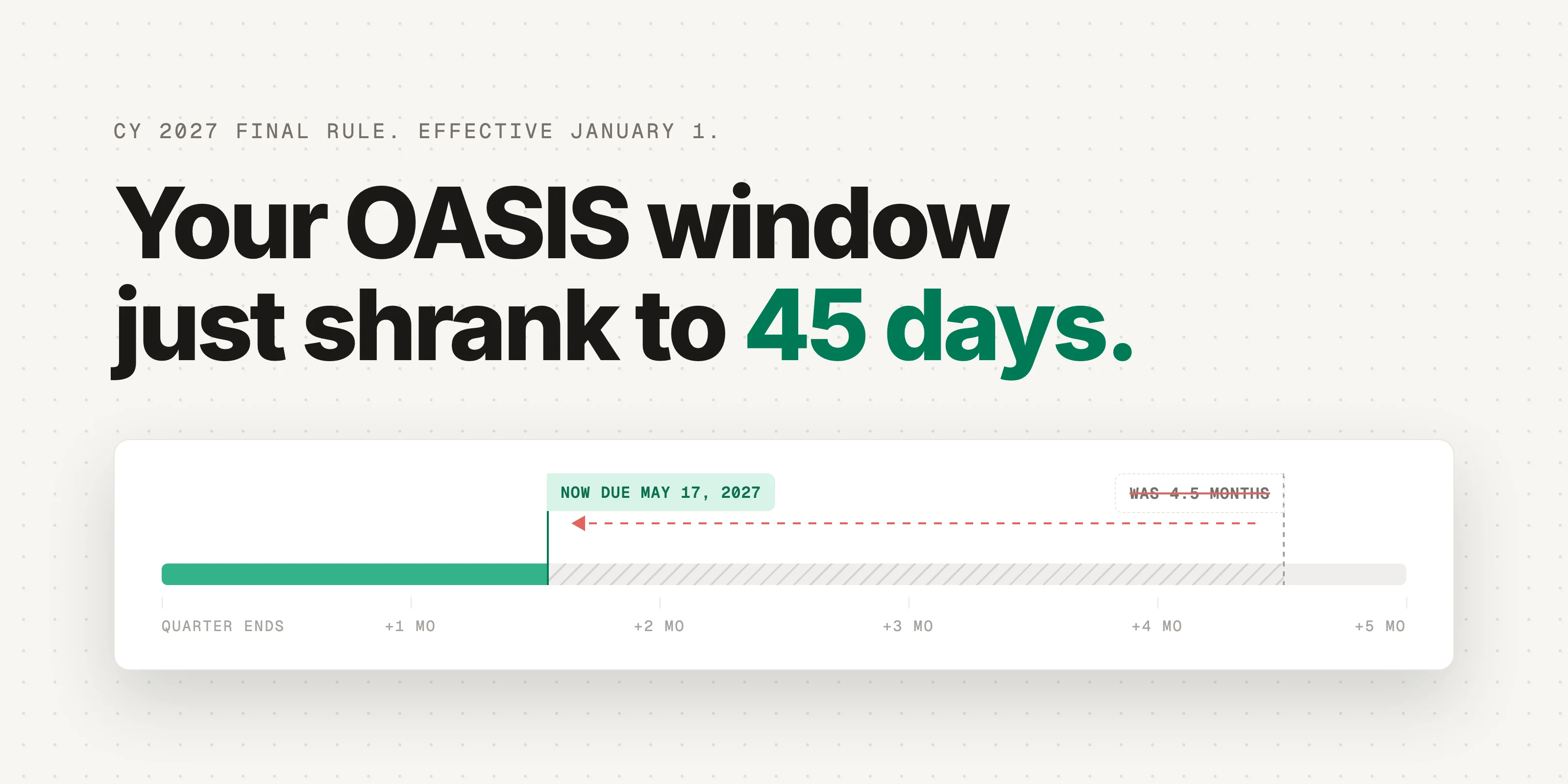
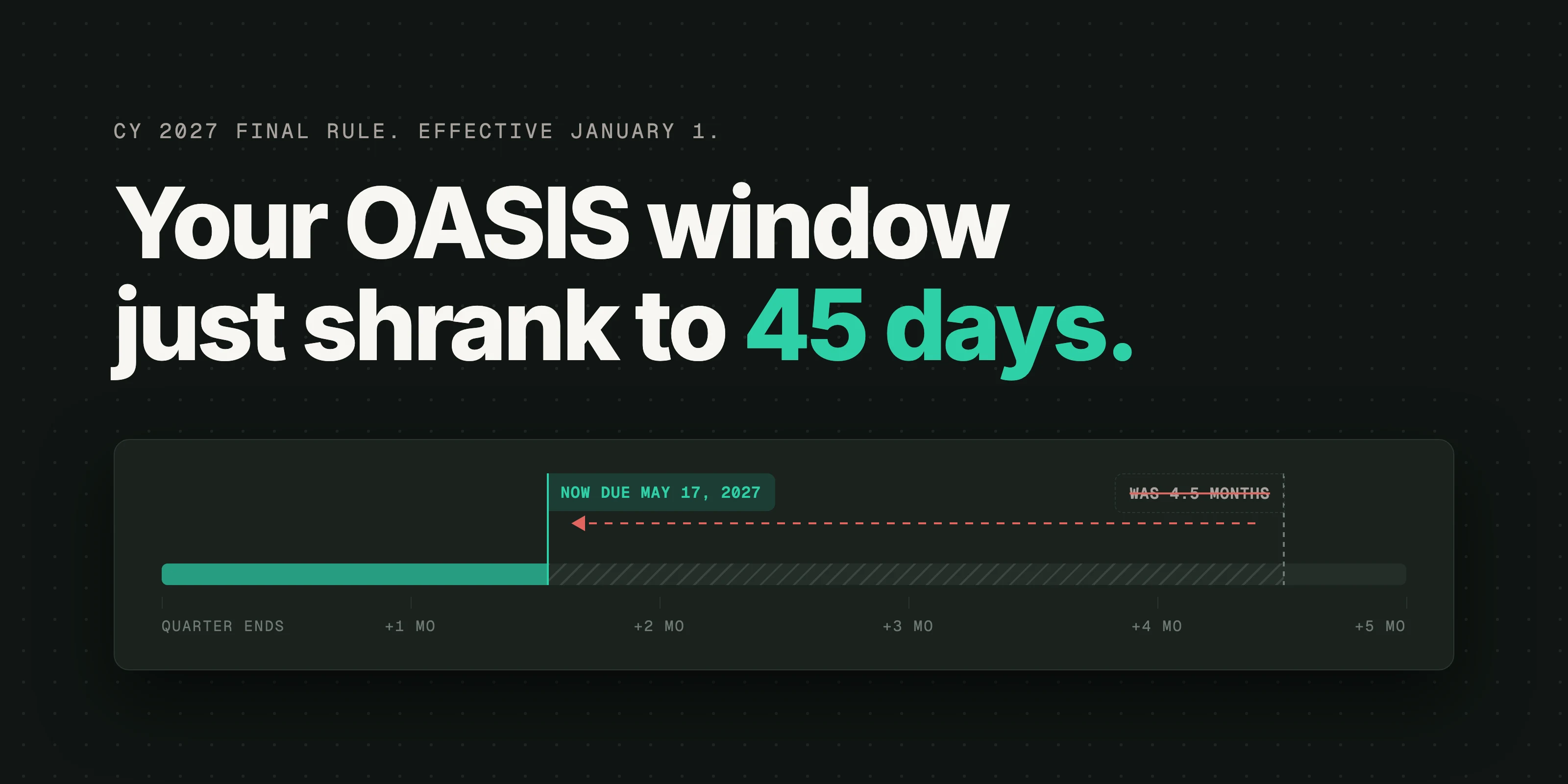
- OASIS corrections are due about 45 days after each quarter ends, down from 4.5 months.
- Quality reporting moves to a calendar year, January 1 through December 31.
- Medicare enrollment revocations can now reach backward to the date the problem started, for every revocation reason.
Sources for everything below: the CMS fact sheet, the CMS press release, and the final rule itself (CMS-1844-F, 91 FR 72022).
1. The rate goes up, and the 3% cut comes with it
The headline is a 2.4% aggregate increase over 2026. Here is how CMS gets there:
- A 3.1% market basket increase, minus a 1.0 percentage point productivity adjustment, equals a 2.1% payment update (about $365 million).
- A lower fixed-dollar loss ratio for outlier payments, finalized at 0.29, adds an estimated 0.3% (about $50 million).
Now the part the headline skips. Since 2020, CMS has held that agencies were paid more under PDGM than the law's budget-neutrality requirement allows. It handled that in two ways. Permanent cuts lowered the base rate going forward, and we covered those four years of cuts here. Temporary cuts recover what CMS says it already overpaid.
For 2027 there is no new permanent cut. There is a temporary one: 3.0% off the national 30-day base rate, the same size as 2026. Per CHAP's summary of the rate tables, the 2027 base rate is $2,092.69. Without the temporary adjustment it would have been $2,157.41. That is $64.72 per 30-day period, before case-mix and wage adjustments, that your agency will not see.
"Temporary" deserves a careful read. By law the adjustment applies to one year only and does not carry into the 2028 rate calculation. But CMS puts the total it intends to recover for 2020 through 2025 at about $4.9 billion, and estimates the 2027 adjustment collects about $500 million, or roughly 10% of it. The rule says CMS may propose more temporary adjustments in future years. Our read: budget as if some version of this cut is with you for a while.
Three other payment details worth knowing:
- Skip quality reporting and the update is 0.1%, not 2.1%. The two-point penalty is unchanged.
- LUPA thresholds moved for 11 of the 432 payment groups: down one visit for ten, up one visit for one. Case-mix weights, functional impairment levels, and comorbidity subgroups were all recalibrated on 2025 claims.
- The wage index still comes from hospital data, with the 5% cap on year-over-year decreases. CMS asked for input on a home health-specific wage index but decided nothing.
2. OASIS corrections are due in about 45 days, not 4.5 months
This is the change most likely to catch an agency off guard.
Today you have roughly 4.5 months after a quarter ends to submit OASIS assessments and fix errors for the Quality Reporting Program. Starting with 2027 data, the deadline is the 15th day of the second month after the quarter ends. If the 15th lands on a Friday, a weekend, or a federal holiday, it moves to the next business day.
For 2027 that works out to:
- January through March: due May 17, 2027
- April through June: due August 16, 2027
- July through September: due November 15, 2027
- October through December: due February 15, 2028
CMS wants this because the long window is the main reason public quality data runs about nine months stale. Cutting it should get data onto Care Compare up to three months sooner.
CMS also argues almost nobody will notice. Using 2024 data, it found 99.27% of OASIS assessments already arrive within 45 days, and it declined requests for a phase-in or grace period. That is true on average. It is less comforting if your agency is the one that batches corrections at quarter-end, or leans on an outside coder who works a backlog.
Two things this does not change. The Condition of Participation that requires transmitting each OASIS within 30 days of completing it is the same as before. And the 90% submission threshold for avoiding the two-point penalty is still 90%.
3. Quality reporting moves to a calendar year
Since 2007, the reporting year that decides whether you get your full payment update has run July 1 through June 30. Starting January 1, 2027 it runs January 1 through December 31, matching the payment year and the Value-Based Purchasing model.
The switch needs a short transition year, and you are already in it:
- 2028 payment update: judged on OASIS data from July 1 through December 31, 2026 (six months) and HHCAHPS data from April 1 through December 31, 2026 (nine months).
- 2029 payment update and after: judged on the full calendar year, starting with January 1 through December 31, 2027.
A six-month window means less room to average out a bad stretch. If your submission rate dipped this fall, now is the time to find out.
CMS proposed no changes to the Value-Based Purchasing model itself. 2027 is its fifth performance year.
4. Enrollment rules that can reach backward
CMS led its own announcement with this section, and estimates it saves about $82 million a year. It applies to all Medicare providers, with a few items aimed at home health and hospice.
- Retroactive revocations, across the board. Some revocations used to take effect 30 days after the notice was mailed. Now every revocation reason can be made effective the date the noncompliance began, which lets CMS recover payments back to that date.
- Ownership changes get enforced. The 36-month rule already says that if an agency changes majority ownership within 36 months of enrolling, or of its last such change, the provider agreement does not transfer. The new owner enrolls as a new provider and goes through a survey or accreditation. CMS can now deny or revoke enrollment outright for failing to comply, and the rule specifically calls out management agreements used to disguise an early sale.
- Owners and managers count. License suspensions and program exclusions involving an agency's owners or managing employees can now be grounds for denial or revocation.
- Crowded markets are a risk factor. CMS can revoke an enrollment it judges to be high risk because of an excessive number of providers in a limited geographic area. CMS says it will weigh the facts of each case.
If you are buying, selling, or bringing in an investor, this section is the one to hand your attorney.
One footnote on timing: the payment and quality provisions take effect January 1, 2027. The rule's notice lists the remaining provisions as effective "January 4, 2026," which reads as a typo for 2027. Confirm dates with counsel before relying on them.
5. Palliative care: clarified, not created
CMS used the rule to state plainly that the existing home health benefit can cover skilled palliative care, such as pain and symptom management, for patients who meet the usual home health criteria. Eligibility turns on skilled need, not on a diagnosis or a terminal prognosis, and it is separate from hospice.
This is not a new benefit and there is no new billing code. CMS says it will add palliative care examples to the Medicare Benefit Policy Manual after the rule. Until those appear, document the skilled need the way you always have.
Seven things to do before January 1
- Re-run your 2027 budget with the $2,092.69 base rate and your own wage index, not the 2.4% headline.
- Ask your EHR vendor when the 2027 grouper, case-mix weights, and LUPA thresholds will be loaded.
- Check which of your common payment groups had a LUPA threshold change, and make sure scheduling knows.
- Put the four OASIS deadlines above on the calendar, and move any quarter-end correction work to a monthly rhythm.
- Pull your OASIS submission rate for July through December 2026. That half-year alone decides your 2028 update.
- If coding or OASIS review is outsourced, get the vendor's turnaround commitment in writing.
- If any ownership change is planned or recent, have counsel review it against the 36-month rule.
What the rule does not change
- The face-to-face encounter requirement for home health. The face-to-face change in this rule is for replacement medical equipment only.
- The Notice of Admission and its five-day clock.
- The Value-Based Purchasing measures and scoring.
- The OASIS instrument itself. CMS only gathered comments on future measures, including advance care planning.
Common questions
Is the 3% cut on top of last year's 3% cut?
No. The 2026 temporary cut expires with 2026 and a new 3% cut applies for 2027. The effect on the rate is the same size, not doubled.
Does the shorter OASIS deadline start with assessments done now?
No. It starts with the first quarter of 2027, with the first deadline on May 17, 2027.
Will CMS cut the base rate permanently again?
Not in 2027. CMS says it will keep analyzing claims through 2026 as the law requires, so the question comes back next year.
Where is the official text?
The final rule in the Federal Register, published November 9, 2026, starting at page 72022.
Where Cardon fits
Most of this rule comes down to timing: visits that land above or below a LUPA threshold, paperwork that has to be clean before a clock runs out. That is the part of the agency we build software for. Cardon schedules visits against the orders and catches what is missing at intake, so fewer problems survive long enough to become a correction or a denial.
If you want to see what the 2027 changes mean for your agency's week, book a demo.