Summary
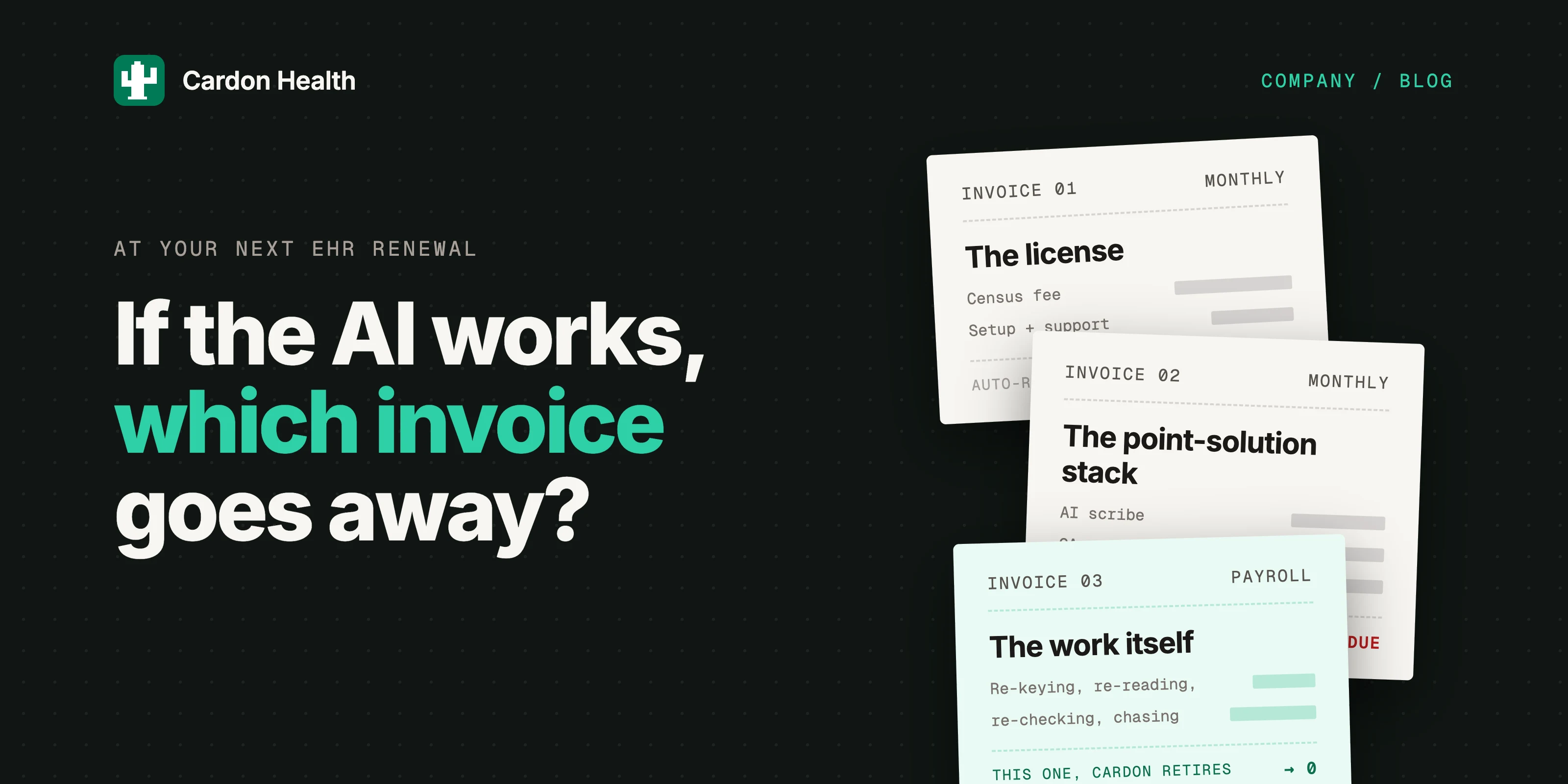
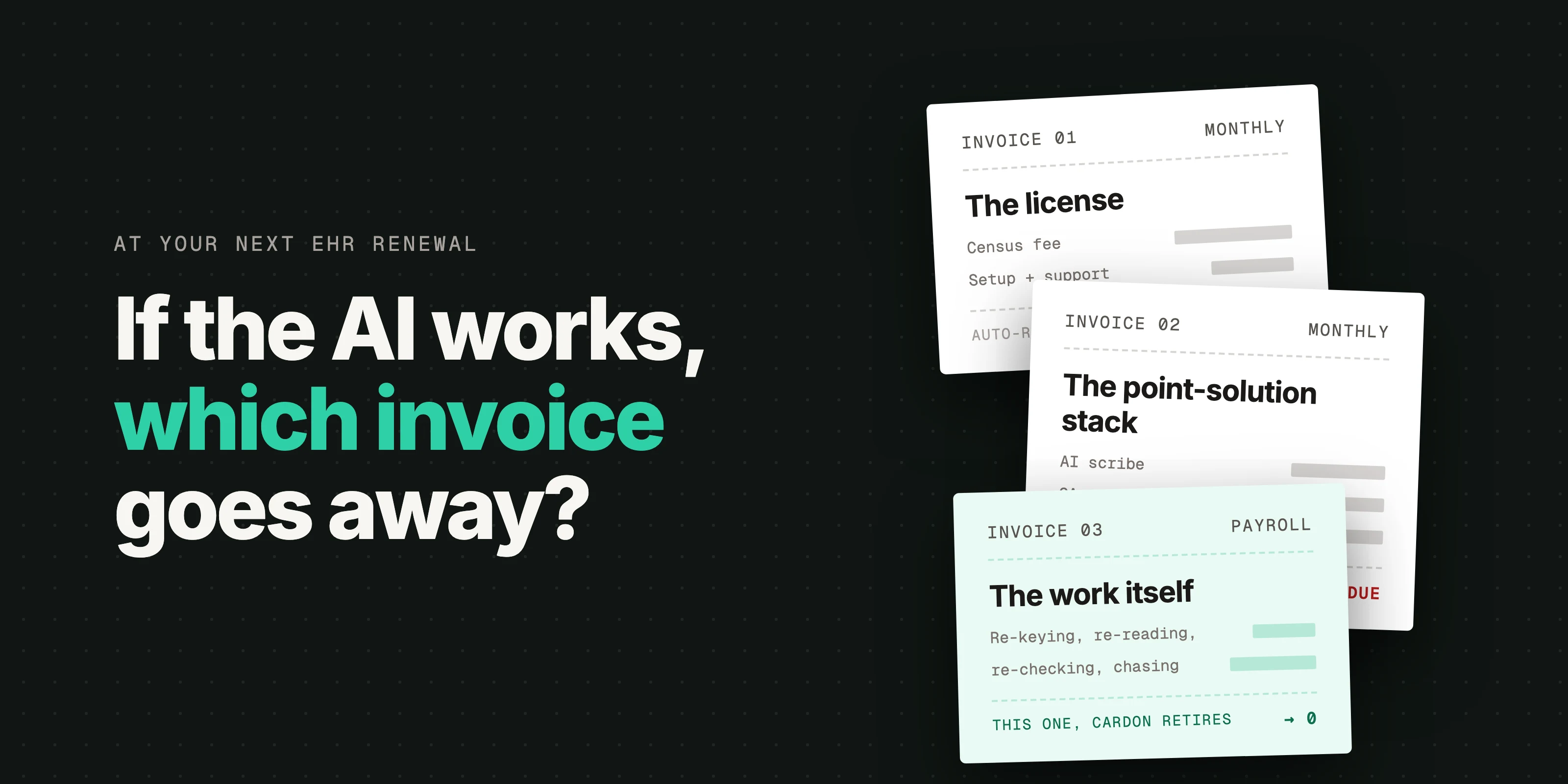
Every legacy EHR now has an AI feature list, and none of it changes what an agency actually pays: the license, the stack of point solutions on top, and the payroll the software quietly assumes. Here's the arithmetic behind those three invoices, and why we decided the fix is a new EHR, not a new feature.
There's a question worth asking your EHR vendor at renewal time, right after they finish the slide about their new AI features: if the AI works, which invoice goes away?
Not "which task gets faster." Which invoice. Because an agency doesn't pay for its EHR once, it pays three times, and the AI feature list touches none of it.
The three invoices
The first invoice is the license. Legacy home-health EHR pricing is quote-only, and the quotes follow a pattern: a monthly fee that scales with your census, a setup fee on top, and an implementation measured in months. For a mid-size agency the monthly line runs well into four figures; industry pricing guides put larger implementations in the five-to-six-figure range before the first visit is ever documented. The pricing model itself tells you what you're buying: a system of record that charges you for growing, whether or not it helps you grow.
The second invoice is the stack. Walk through a typical agency's software budget and the EHR is only the anchor tenant. There's an intake tool, because faxed referrals don't parse themselves. A documentation scribe, because OASIS takes 45 to 90 minutes per assessment without one. An outside QA and coding service, because under PDGM a coding miss changes what the episode pays. Maybe a scheduling optimizer. Each one exists because the EHR can't do that job, each one is its own subscription, its own login, its own sales cycle. Agencies aren't buying a platform; they're assembling one, annually, out of parts.
The third invoice is the payroll, and it's the biggest one. Every legacy EHR workflow assumes a person at the keyboard: an intake coordinator re-typing a referral packet into the fields the fax already contained, a QA nurse re-reading charts the system merely stored, a scheduler re-running LUPA arithmetic by hand, a biller chasing a claim the software watched go wrong. None of those salaries show up on the software invoice, but the software is why they're structured the way they are. The real price of a form-based EHR is the staffing model it forces on you.
Now set those three invoices against the direction reimbursement is heading. CMS finalized a permanent −1.975% behavioral adjustment for 2025, MedPAC has recommended a 7% cut for 2027, and expanded Value-Based Purchasing puts up to 5% of Medicare revenue at stake on quality scores. Costs that scale with census, against payment that shrinks per episode. That's the squeeze, and it's structural.
Why a feature can't retire an invoice
Here's the uncomfortable part: a legacy vendor can ship genuinely good AI features and still not change any of this.
A legacy EHR is, architecturally, a filing cabinet with a form-based interface, which is roughly what you get when the money that modernized the rest of healthcare skips your category for fifteen years. Its data model assumes a human reads the screen, makes the decision, and types the result. An AI feature grafted onto that architecture can only accelerate the typing. It drafts the note faster, summarizes the chart faster, autocompletes the field faster. What it cannot do is own the outcome, because the system underneath it has no concept of an outcome. It has forms.
The work of an agency was never "fill in forms." It's "answer this referral before the hospital calls the next agency." It's "keep this episode from quietly falling one visit short of its threshold." It's "get this claim out clean the first time." Those are outcomes that cut across a dozen forms, and a drafting assistant bolted onto form number seven can't carry any of them end to end. A human still has to walk the result from screen to screen, which means the third invoice, the payroll one, survives fully intact.
And there's a quieter reason the invoices survive: the vendor's revenue depends on them. When pricing scales with census and seats, every task the AI truly took over would be revenue the vendor gave back. Bolt-on AI is priced as an add-on because it's designed to be additive. You were paying three times; now you're paying three times plus the AI line.
What building new actually means
We started Cardon from the other end. Instead of asking "where can we sprinkle AI onto the existing workflows," we asked what an EHR looks like if the system, not the staff, is the one doing the administrative work, and the humans are supervising.
Concretely, that's the product that exists today: referrals answered in minutes instead of hours, because reading a referral packet, checking eligibility, and drafting the response is the system's job. Schedules that fill and protect themselves, because watching every episode's visit counts, recert windows, and frequency orders is arithmetic, and arithmetic is what software is for. One system where the referral becomes the admission becomes the schedule becomes the claim, without a person re-keying it at each border crossing.
But "the AI does the work" is exactly the kind of sentence that should make an administrator suspicious, so we hold ourselves to two rules that most AI marketing skips.
- Every action has a receipt. When Cardon does something on your behalf, there's a plain-English record of what it did, what it saw, and why. Not a dashboard you have to interrogate; a paper trail you can audit.
- You set the autonomy, and you can take it back. Every automated behavior is a switch you control, from "draft it and ask me" to "handle it and tell me after," and every action can be undone. A system that works for you should be easier to supervise than an employee, not harder.
That's the honest version of "agentic": not a black box that promises outcomes, but a teammate whose work you can inspect, throttle, and reverse.
The part nobody says out loud
Rip-and-replace is also an invoice. Migrations cost months, retraining costs morale, and every administrator has survived at least one EHR conversion they still describe in war-story tones. Any vendor who says "just switch" is asking you to pay the largest one-time cost in agency software on faith.
So we don't ask that. Cardon runs alongside the EHR you already use. Intake and scheduling are live today, reading from your existing system and writing back only what your team accepts. Your system of record stays the system of record while the new one earns that title the only legitimate way: by doing the work, visibly, with receipts. The invoices come off the table one at a time, starting with the payroll-shaped one, which was always the biggest.
The question to ask at renewal
The legacy vendors aren't wrong that AI matters. They're wrong about where it goes. AI as a feature accelerates the typing and preserves all three invoices. AI as the system retires the work itself, which is the only thing that changes what an agency actually spends.
So ask the question. If the AI works, which invoice goes away? If the answer is a longer feature list on the same contract, you already know what the next renewal looks like.
We'll show you the other answer with your own referrals and your own schedule, in 20 minutes: book a demo.
Keep reading
SchedulingAugust 14, 2026
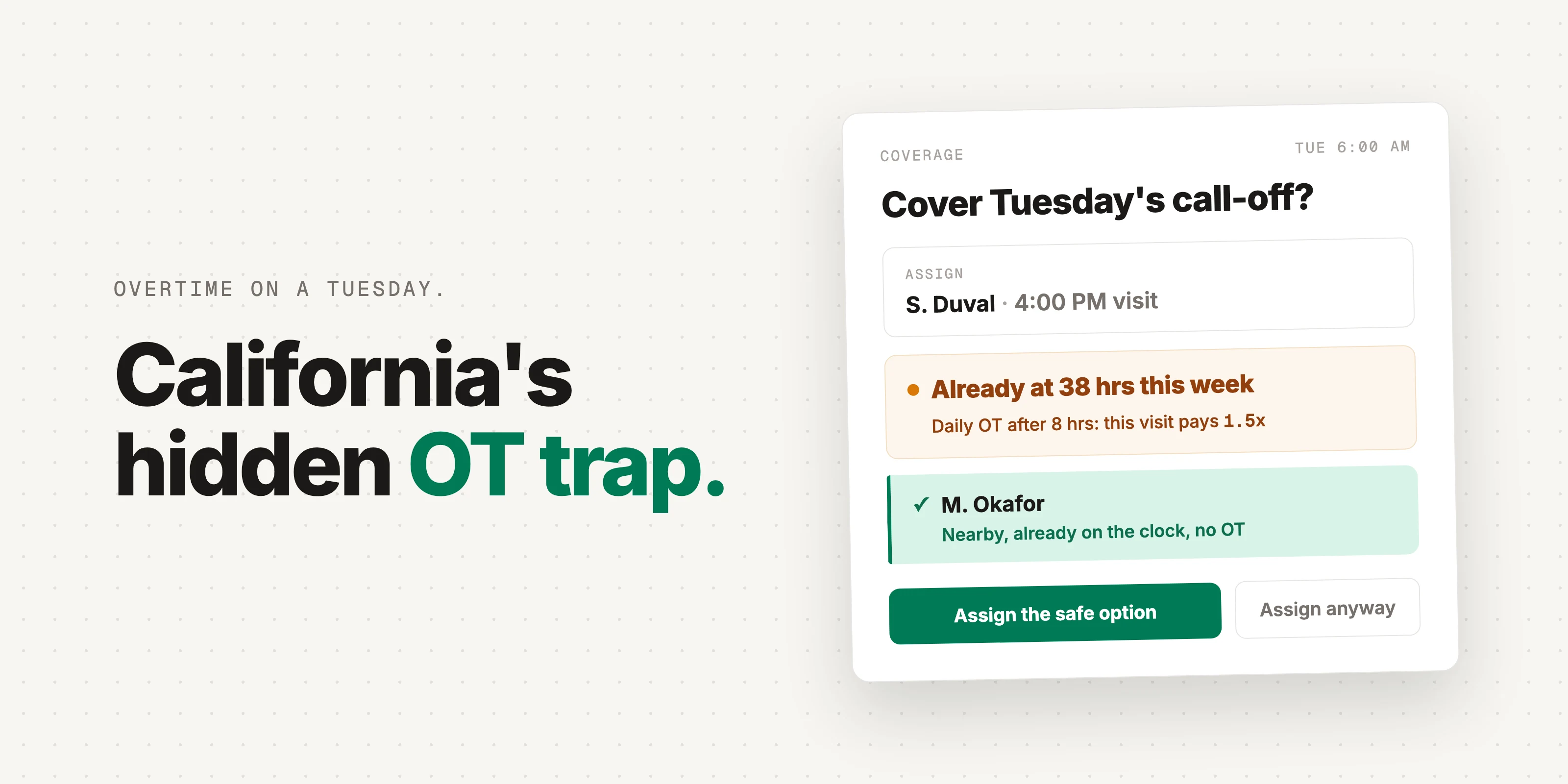
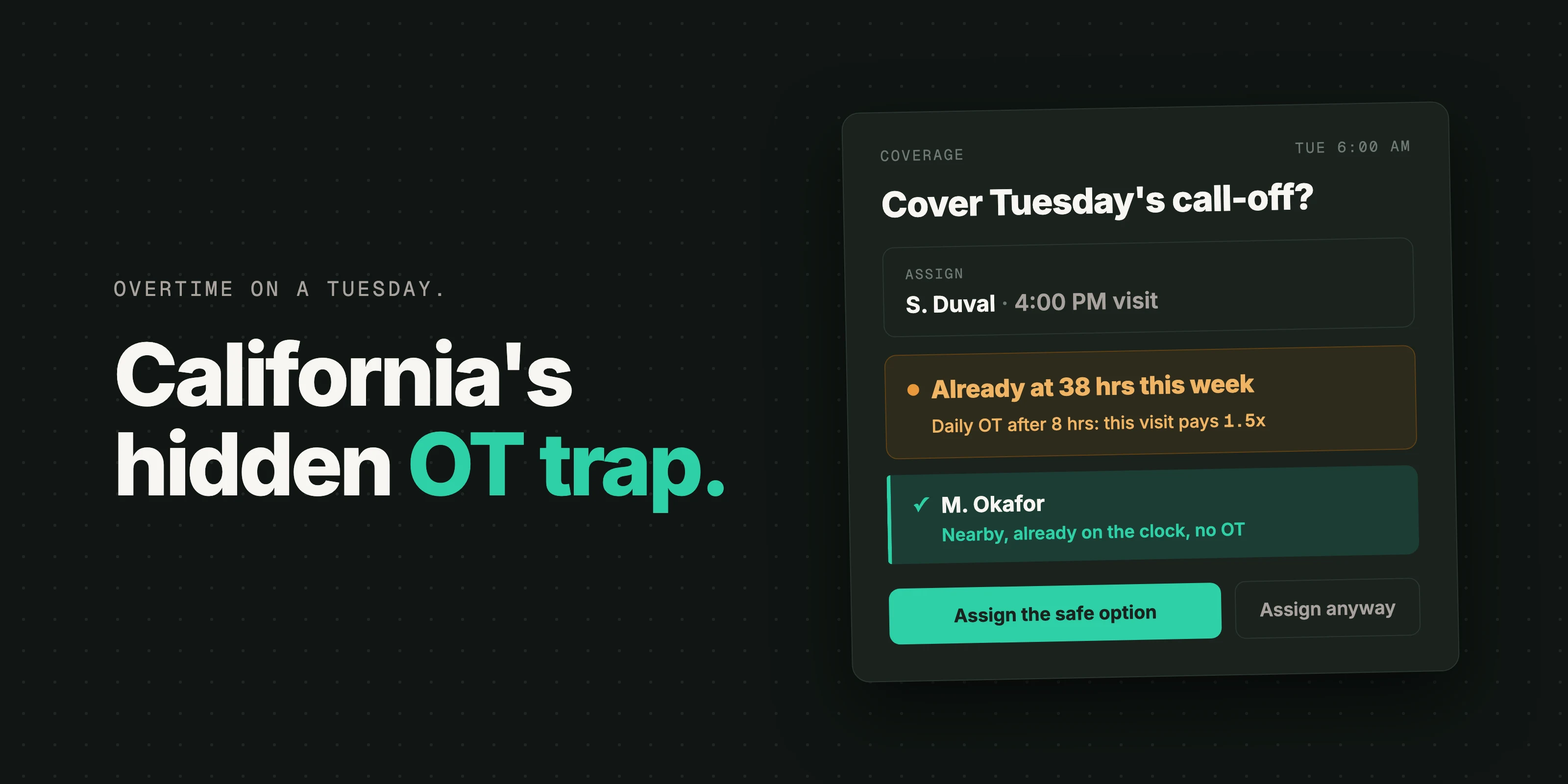
The California Overtime Trap: How Scheduling Blind Spots Quietly Eat Your Margin
In California, a caregiver can hit overtime on a Tuesday. Most agencies don't see it until payroll, when it's already money gone.
IndustryAugust 12, 2026
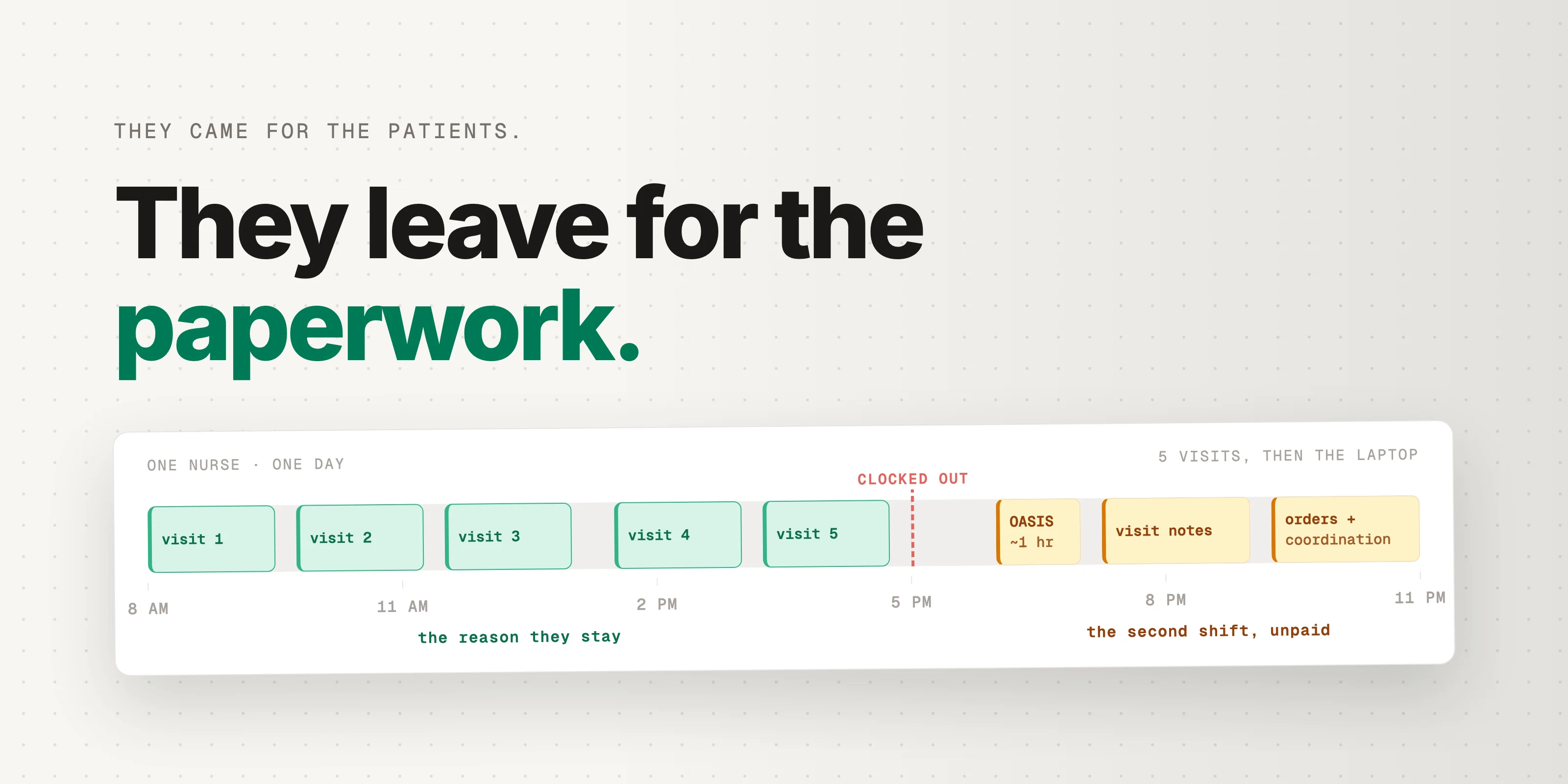
Why Home Health Nurses Quit (It's the Paperwork, Not the Patients)
Nurses don't leave home health because of the patients. They leave because of everything the software makes them do around the patients.
IntakeAugust 10, 2026
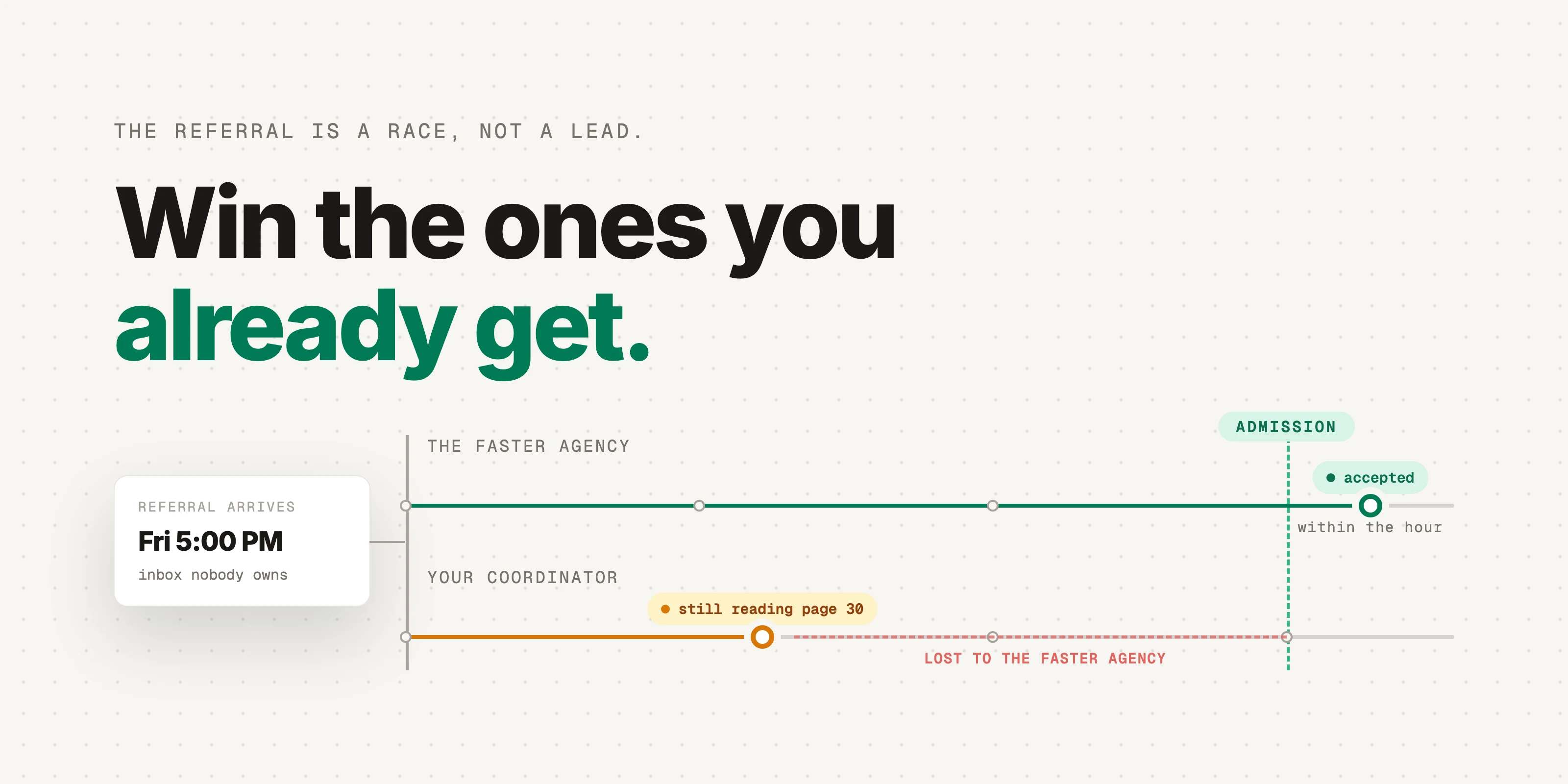
How to Stop Losing Referrals: A Practical Guide to Home Health Intake
The referral you answer in an hour is an admission. The one that sits until tomorrow is a competitor's admission.